- Gen Zers and millennials alike are leaving some of the nation’s biggest, most expensive metros, but they’re at different life stages—and that shows up in where they go.
- Gen Zers are flocking to places with lots of job opportunities for young people, like Washington, D.C., Austin and Nashville, while millennials are heading to places where they can get bigger houses for less money, like Houston and Atlanta.
- A decade ago, twenty-somethings were moving to Texas–and they still are today. But other popular destinations have changed for young movers.
- Both generations are leaving expensive coastal cities like New York and Los Angeles.
- Gen Zers and millennials are mostly making short-distance moves from expensive to more affordable places, like from Los Angeles to neighboring Riverside, or New York to nearby Philadelphia.
Gen Zers and millennials alike are moving away from some of America’s biggest, most expensive cities, but their destinations reflect different stages of young adulthood.
Gen Zers are gravitating toward places like San Antonio, Washington, D.C., Austin and Nashville—metros with plenty of job opportunities for people early in their careers, along with lively social scenes. Millennials favor metro areas like Houston, Las Vegas and Atlanta– places that can offer more affordable housing and space for a generation of people now in their 30s and early 40s.
One thing the generations have in common: New York and Los Angeles are among the places they’re most commonly leaving. And many of the most popular moves for both generations are relatively short hops between neighboring metros.
“Gen Zers are chasing opportunity, while millennials are chasing space,” said Sheharyar Bokhari, a principal economist at Redfin. “Younger adults are gravitating toward cities where they can launch careers and their social lives, while millennials are more focused on places where a paycheck stretches further and buying a home is attainable. But young Americans aren’t fleeing expensive cities for the cheapest place they can find: Most are making relatively short moves, suggesting they want a better job or lower cost of living without giving up their existing networks. And the fact that expensive coastal cities are losing residents from both generations is a reminder that even the biggest job centers can lose their pull when housing costs get too high.”
Gen Zers Are Flocking to San Antonio
San Antonio is the most popular migration destination for Gen Zers, with 10,678 more Gen Zers moving into the metro than moving out. Next comes Washington, D.C., with a net inflow of 8,631.
Rounding out the top five are two more Texas metros, plus one in Tennessee: Austin (net inflow of 8,590), Nashville (+8,093) and Dallas (+6,944).
Three of those five metros are in Texas, and several stand out as particularly attractive places to start a career. A separate Redfin and Glassdoor analysis ranked Washington, D.C. as the best big U.S. city for recent college graduates, while Dallas is fourth and Austin is 10th. The ranking considered career opportunities, housing affordability and quality of life.
Kristin Sanchez, a Redfin Premier agent in Nashville, says she’s still seeing some young remote workers move into the area for a lower cost of living and fun vibes–and there is also an influx of companies bringing workers into offices there, like Amazon and Apple.
“Nashville has become a magnet for young professionals because the job market is growing right alongside the city,” Sanchez said. “We’re seeing companies expand or relocate here, bringing opportunities in healthcare, tech and entertainment that are especially appealing to people early in their careers. And for Gen Zers coming from expensive places like California or New York, Nashville can offer the best of both worlds: a vibrant city with strong career opportunities where their money can go further.”
New York is losing more Gen Zers than any other metro. The Big Apple posted a net outflow of 29,554. It’s followed by Minneapolis (-17,815), Los Angeles (-16,465), Denver (-13,882) and Detroit (-11,696).
Affordability–or lack thereof–is part of the story in pricey New York and Los Angeles, but Gen Z migration isn’t purely about housing costs. Moves among young adults are also heavily influenced by college, first jobs and the transition from school into the workforce.
Texas Has Always Been a Hotspot For Young Movers–But Other Popular Destinations Have Changed Over the Last Decade
Twenty-somethings were moving to different places a decade ago–with a few exceptions. In 2014, the most popular destinations for millennials (then 19-33 years old) were Sacramento, CA , Austin, Dallas, Columbus, OH and Seattle. The only places on both top-five lists for the youngest adults today (Gen Z) and the youngest adults a decade ago are Austin and Dallas; Austin is known for both its strong job market and vibrant live-music and food culture.
Back in 2014, when the U.S. was coming out of the Great Recession, young people were flocking to smaller cities instead of the most well-known job hubs, like New York and Los Angeles. Those slightly smaller cities offered a combination of strong job markets and proximity to recreation.
On the flip side is the metro areas young people were leaving a decade ago. In 2014, 19-33 year olds were most commonly moving away from New York, Chicago, Los Angeles, San Diego and Miami. New York and Los Angeles are still on the list.
Houston and Dallas Are Now the Top Destinations For Millennial Movers
Houston is the most popular destination for millennials today, with 16,365 more millennials moving into the metro than leaving. Dallas comes next, with a net inflow of 13,072.
They’re followed by Baltimore (+11,724), Las Vegas (+8,860) and Atlanta (+8,753).
Millennials are in their 30s and early 40s, ages when buying a home and finding more space can weigh more heavily on moving decisions. Their top destinations are large employment centers where housing generally costs less than in coastal cities like New York, Los Angeles and San Francisco. All five of the most popular destinations for millennials have a median home-sale price of less than $450,000.
Like Gen Zers, millennials are leaving New York at a faster rate than any other metro area, with a net outflow of 42,698. It’s followed by Los Angeles (-31,107), Miami (-21,373), Washington, D.C. (-12,364) and San Francisco (-11,819).
Washington, D.C. offers perhaps the clearest generational contrast: It’s the second-most popular destination for Gen Zers but one of the places millennials are most commonly leaving. That fits with D.C.’s strength as a launching pad for recent graduates: Younger adults may arrive for early-career opportunities, while older millennials may move elsewhere once their careers are established as they start families and their housing needs change.
For Gen Zers and Millennials, the Most Common Moves Are Short Hops, Not Cross-Country Treks
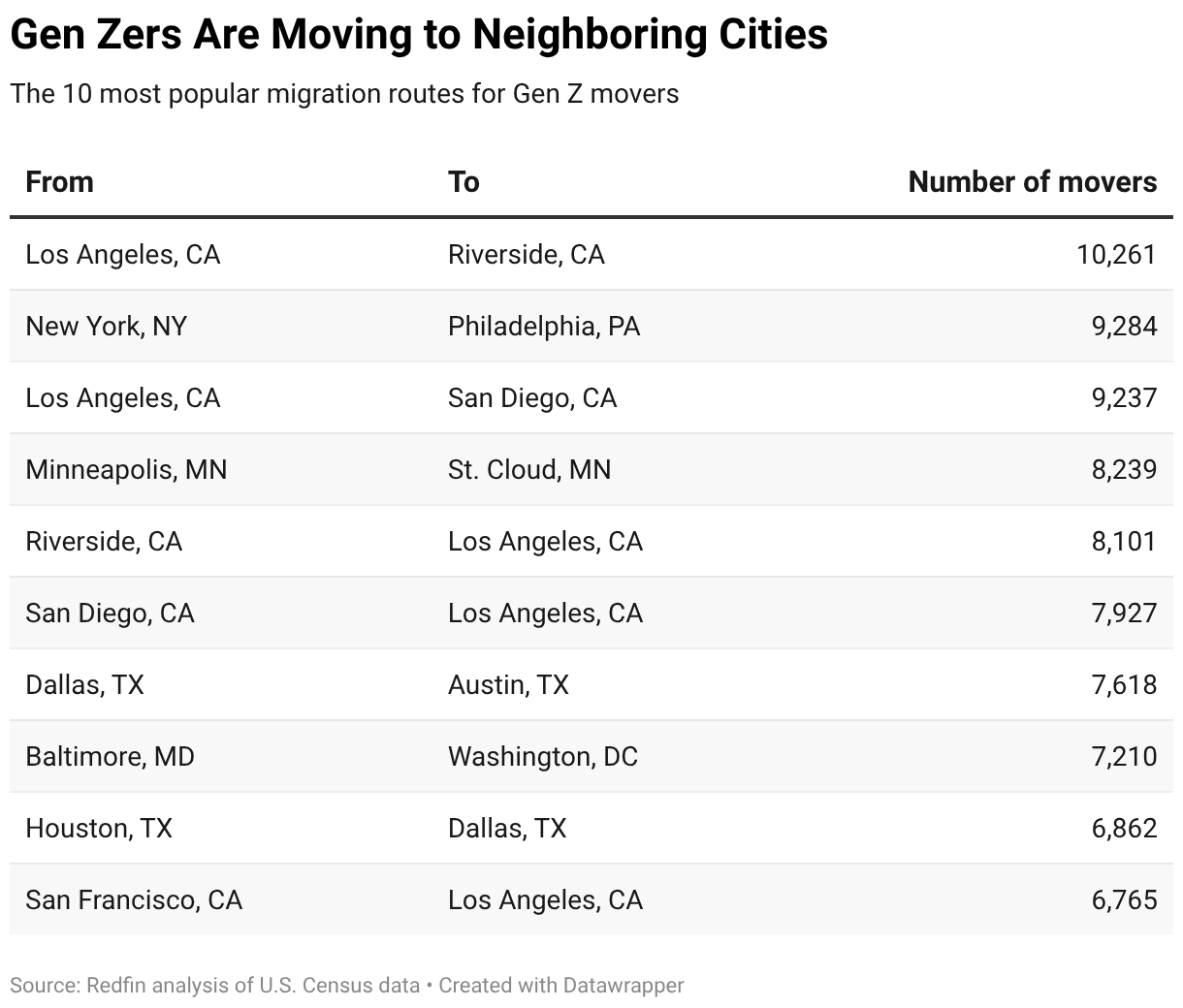
The most common Gen Z route is Los Angeles to Riverside, CA, with 10,261 members of the generation making that move in 2024. The Riverside metro area, roughly 60 miles east of downtown Los Angeles, is made up mostly of Inland Empire cities like Ontario and San Bernardino; many residents commute to jobs in L.A.
The next-most common routes for Gen Zers are also fairly short moves: New York to Philadelphia (9,284 movers), and Los Angeles to San Diego (9,237 movers). In fact, all of the top 10 routes are between nearby metros, including Minneapolis to St. Cloud, MN, Dallas to Austin, and Baltimore to Washington, D.C.
Rather than making major cross-country moves, many Gen Zers are reshuffling within the regions they already live in as they pursue jobs or cheaper housing. The typical home in New York, for instance, sells for $832,000, compared with $309,000 in Philadelphia, and the typical home in Minneapolis sells for $404,000, compared with $323,000 in St. Cloud.
But it’s not all about affordability: Gen Zers are moving from Riverside to Los Angeles, too, and from Baltimore to Washington, D.C. Those are likely job-related moves, with Gen Zers relocating to nearby hubs either to seek employment or because they got a new job.
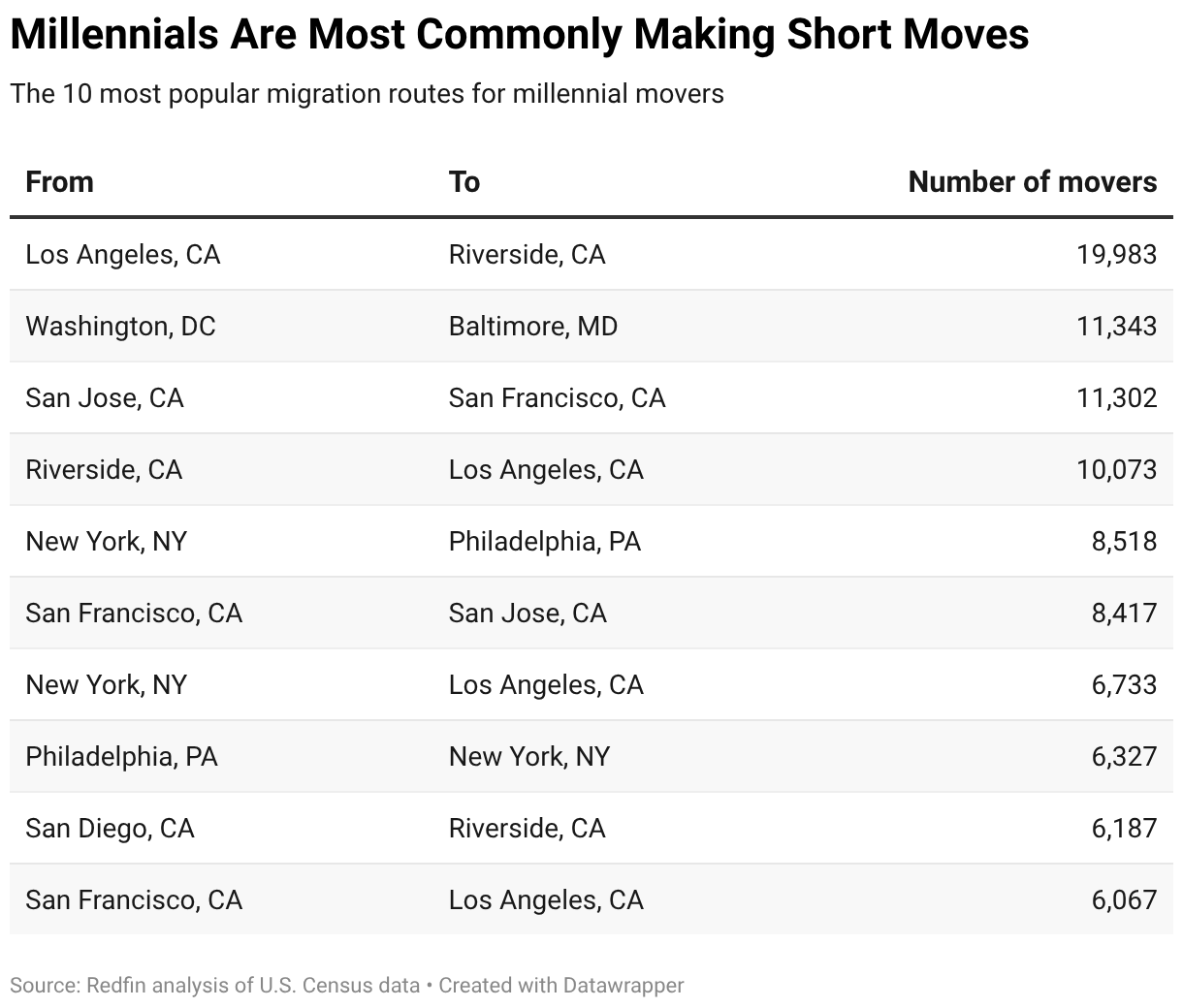
Like Gen Zers, millennials frequently move between neighboring metros. Also like Gen Zers, their most popular route is Los Angeles to Riverside, with 19,983 movers. Next come Washington, D.C. to Baltimore (11,343 movers), and San Jose to San Francisco (11,302).
For millennials, some of those moves offer a clear housing tradeoff: relocating from Los Angeles to Riverside or from Washington, D.C. to Baltimore can provide access to more affordable housing without leaving a region altogether. There’s one notable exception to the short-move pattern: The seventh-most common route for millennials is from New York to Los Angeles, the only cross-country route on the top 10 list.
Young Americans aren’t abandoning expensive cities for far-flung affordable ones. Gen Zers appear especially drawn to places where they can launch careers, while millennials are gravitating toward places that may better accommodate the housing and space needs that come later in adulthood.
Big Moves Are Becoming Slightly Less Common For Young Adults
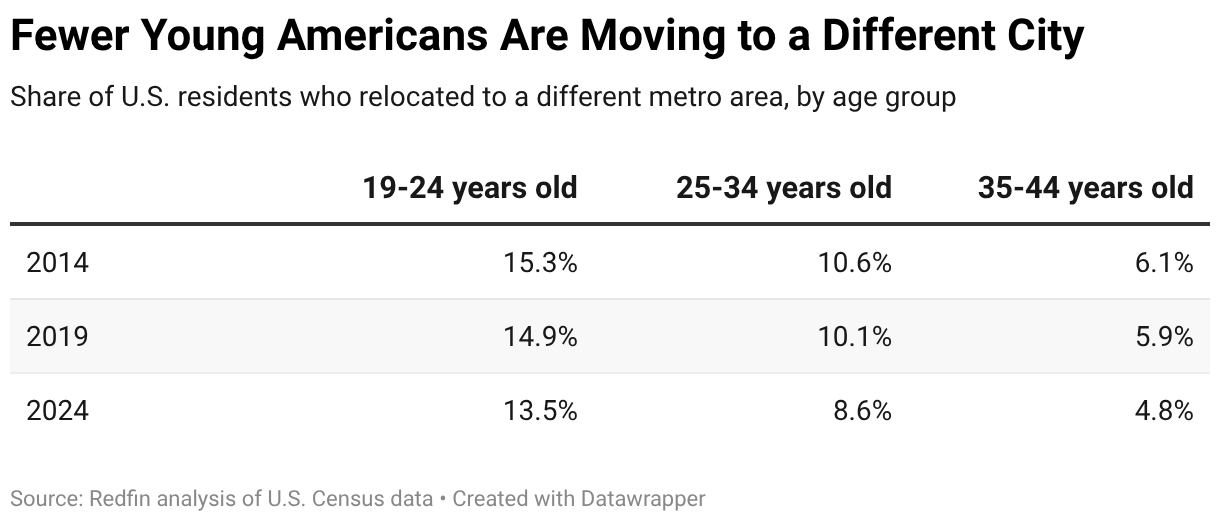
Young adults are a bit less likely to make a major move than they were a decade ago–or even just before the pandemic. Roughly 14% of 19-24 year olds moved away from their metro area in 2024, down from roughly 15% in 2014. And roughly 9% of 25-34 year olds relocated in 2024, down from about 11% in 2014.
Remote work has made it possible for young adults to start their careers or change jobs without changing cities, and high housing costs in certain places may be discouraging some would-be movers.
Methodology
This analysis is based on the U.S. Census Bureau’s American Community Survey (ACS) 1-year microdata for 2014, 2019 and 2024, and includes adults (19+) only. Generations are defined by birth year: Gen Zers were born 1997-2012 (adult Gen Zers were 19-27 in 2024), millennials 1981-1996 (28-43 in 2024), Gen Xers 1965-1980 (44-59), and baby boomers 1946-1964 (60-78).
A mover is an adult who no longer lives in the metro area where they had lived one year earlier. Metro areas follow the 2013 OMB metropolitan delineations, the vintage identified in the ACS microdata. Net migration for a metro is the number of a generation’s movers arriving minus the number leaving, among moves where both the origin and destination metros are identified.
To guard against small-sample noise, figures based on fewer than 25 unweighted survey records are not reported, and single-year net gains exceeding 4% of a generation’s population in a metro are excluded as college or military enrollment spikes rather than housing moves. ACS data was retrieved from IPUMS USA: Steven Ruggles, Sarah Flood, Matthew Sobek, Daniel Backman, Annie Chen, Grace Cooper, Stephanie Richards, Renae Rogers, and Megan Schouweiler. IPUMS USA [dataset]. Minneapolis, MN: IPUMS.a