- An analysis of domestic migration data shows high-flood-risk counties lost nearly 30,000 more residents than they gained last year, driven largely by outflows from Miami and Houston.
- Some are leaving due to climate risk, while others are moving out in search of a lower cost of living or different politics. Redfin agents say many are “boomerang” migrants—people who moved to flood-prone America during the pandemic and then decided to return home.
- While domestic migration to flood-prone areas has slowed, many of these areas are still experiencing population growth due to immigration. But that could change as the government cracks down on border crossings.
Flood-prone America is losing more residents than it’s gaining for the first time since 2019.
High-flood-risk counties saw 29,027 more people move out than in last year. By comparison, low-flood-risk counties saw 35,941 more people move in than out—the largest gain since 2019.
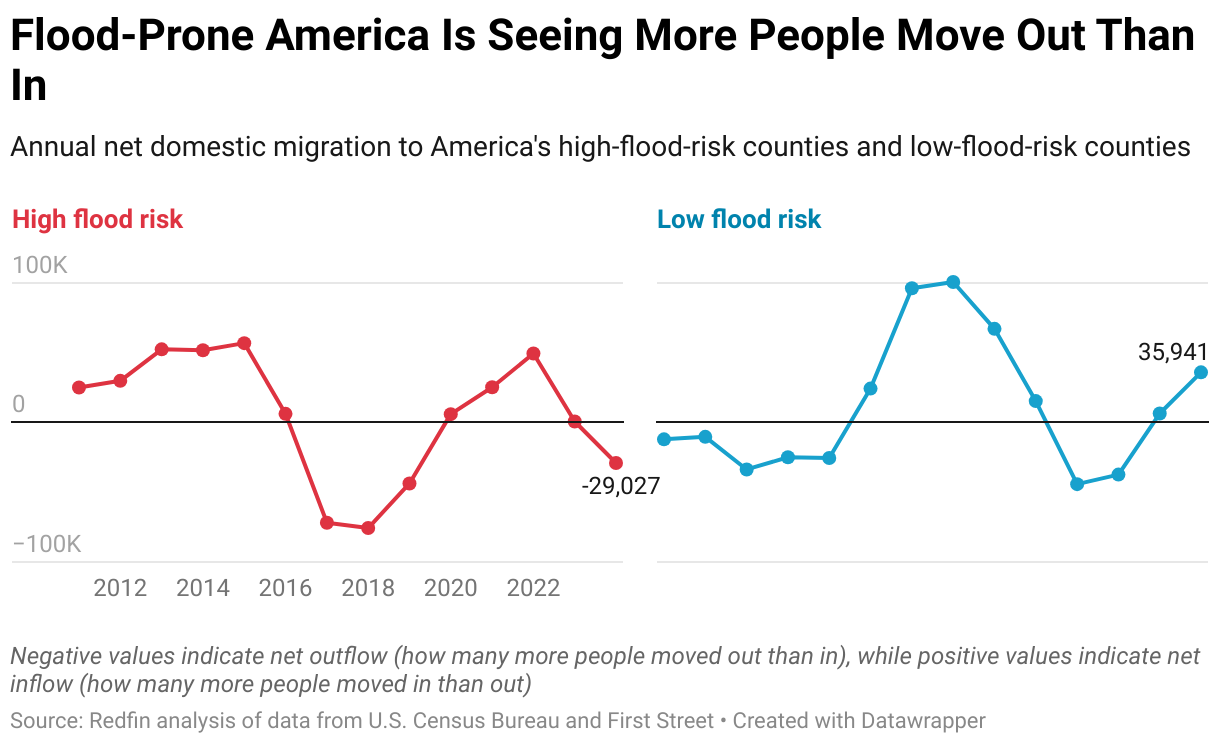
This is based on a Redfin analysis of domestic migration data from the U.S. Census Bureau (excludes immigration) and climate-risk scores from First Street. We define a high-risk county as one that ranks in the top 10% when it comes to the share of homes facing high flood risk—in other words, counties with 23.7%-99.1% of homes facing high risk. Migration data for 2024 covers July 1, 2023-July 1, 2024. A “net outflow” measures how many more people moved out of than into an area, while a “net inflow” measures how many more people moved in than out. These data are subject to revision.
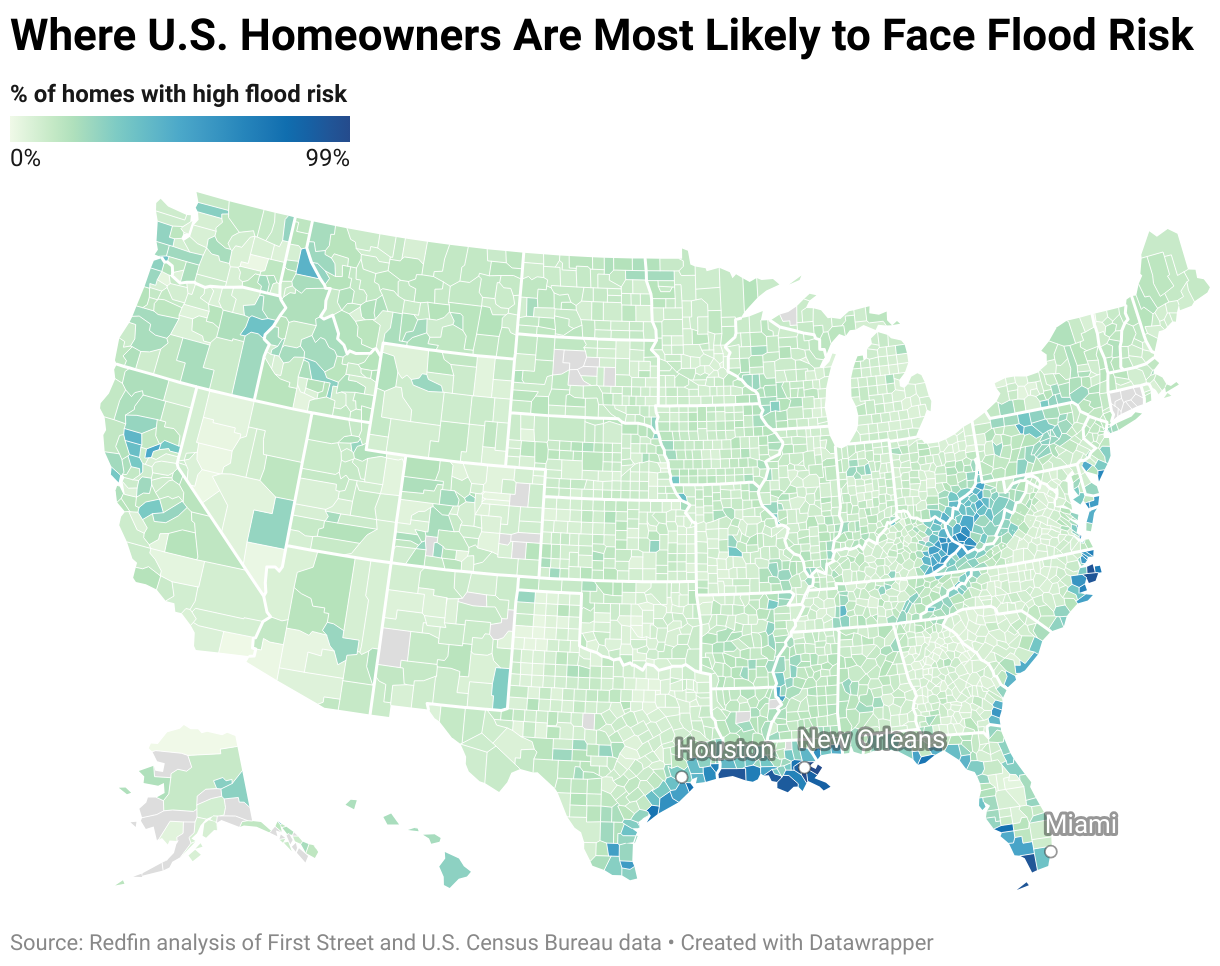
Major hubs in coastal Florida, Texas, New York and Louisiana were driving forces behind the national net outflow last year. Miami-Dade County, where over one-third of homes face high flood risk, saw 67,418 more people move out than in—the largest net outflow among the 310 high-flood-risk counties Redfin analyzed. Next comes Harris County, TX (home to Houston), which saw a net outflow of 31,165. In third place is Kings County, NY (home to Brooklyn), which saw a net outflow of 28,158. Also notably on the top 10 list with a net outflow of 4,950 is Orleans Parish, LA (home to New Orleans), where 99.1% of homes face high flood risk—the highest share in the nation.
The 10 high-flood-risk counties with the largest net outflows in 2024
| U.S. county | Net domestic outflow | Share of homes facing high flood risk |
| Miami-Dade County, FL | -67,418 | 36.3% |
| Harris County, TX | -31,165 | 31.3% |
| Kings County, NY | -28,158 | 25.0% |
| Hudson County, NJ | -12,735 | 27.2% |
| Jefferson Parish, LA | -5,126 | 98.8% |
| Orleans Parish, LA | -4,950 | 99.1% |
| Pinellas County, FL | -3,973 | 35.8% |
| Norfolk City, VA | -2,550 | 32.4% |
| Cameron County, TX | -1,946 | 28.0% |
| Fairbanks North Star Borough, AK | -1,849 | 28.8% |
Most of these counties have been seeing more people move out than in for years but some experienced an acceleration in this trend last year. For example, Miami’s net outflow widened to 67,418 in 2024 from 50,637 in 2023—the largest acceleration of any high-flood-risk county.
Redfin agents in flood-prone areas say high housing costs, climate risk, rising insurance premiums and politics are among the factors that have made people reluctant to stay or move in.
“A lot of people moved to Miami during the pandemic, thinking life would be a vacation,” said local Redfin real estate agent Ozzie Linares. “Many of those people are now leaving because they’ve realized living here isn’t a piece of cake—the city has become increasingly expensive and extreme weather events are on the rise. We were just under a flash flood warning due to higher-than-normal king tides.”
Linares said his homeowner’s insurance premium has risen to $6,700 per year from less than $2,000 two years ago, and his flood insurance premium has climbed to $1,250 from around $400. Insurance premiums are rising across the country due to intensifying climate risk.
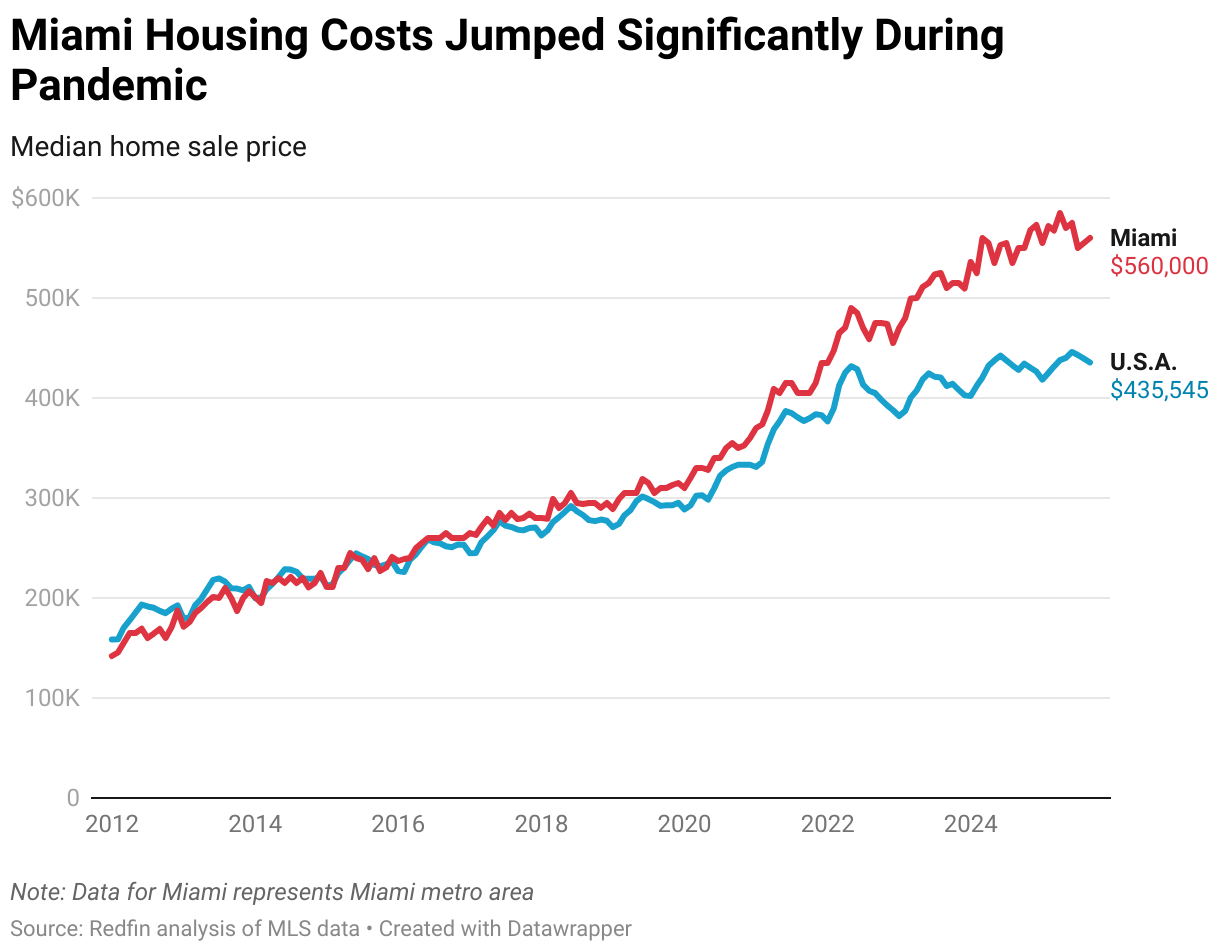
Soaring insurance costs, HOA dues and condo special assessments have added insult to injury for buyers already contending with high home prices and mortgage rates—especially in Florida. The 2021 collapse of a condo building in Surfside, FL, which killed nearly 100 people, led to a new law requiring condo buildings to undergo structural inspections and shore up reserves. Many HOAs have been hiking fees and doling out hefty special assessments to comply with the new rules, reducing demand for condos—a very common property type across coastal Florida.
A decade ago, flood-prone America was seeing more people move in than out, primarily driven by migration to the Houston area and Cape Coral-Fort Myers, FL. But in 2016, the Houston area started seeing more people leave than move in—a trend that accelerated in 2017-2019 and helped trigger a national net outflow from flood-prone areas. Many Houstonians left during this time due to Hurricane Harvey. The area had also been grappling with a bust in the oil industry, which continues to face challenges today. The national outflow from flood-prone areas reversed during the pandemic as scores of remote workers moved to beachfront Florida and other at-risk parts of the Sun Belt. And now we’re seeing yet another reversal—many people are leaving flood-prone America today, this time due to factors including high housing costs, politics and climate risk.
Some People Are Leaving Flood-Prone America Because Their Homes Have Been Destroyed
While many people are leaving flood-prone areas for affordability reasons, others are leaving because they have been personally impacted by flooding.
Pinellas County, FL, which is on the Gulf Coast and home to St. Petersburg, is the only county in the table above that experienced its first net outflow in many years. Local Redfin real estate agent Dawn Liedtke said this exodus intensified after Hurricane Helene hit at the end of 2024, causing an estimated $93 million in damage.
“A huge part of the Pinellas County population was forced to leave because their homes were flooded in Hurricane Helene,” Liedtke said. “It made people reevaluate whether they want to live in an area with flood risk. A lot of sellers I worked with after the storm moved to non flood zones in neighboring Pasco County, but we also saw many people move out of state.”
Pasco County saw a net inflow of roughly 20,000 people last year—the third highest in the nation. Just 18.1% of homes face high flood in Pasco County, compared with 35.8% in Pinellas County.
Houston, Which Faces Multiple Climate Risks, Sees Exodus of Residents Intensify
Harris County, TX saw its net outflow widen to 31,165 in 2024 from 22,035 in 2023—the second biggest acceleration among high-flood-risk counties.
Nearly 1 in 3 (31.3%) homes face high flood risk in Harris County, but Houston also faces other climate risks, namely extreme heat—100% of homes in Harris County face high heat risk. The area has also faced bouts of extreme cold, including the Great Texas Freeze of 2021, which caused widespread power outages.
“People are always nervous about flooding in Houston, but it’s no longer the top concern like it was after Hurricane Harvey,” said local Redfin Premier real estate agent Roze Swartz. “I’m working with a lot of home sellers who moved to Texas from the West Coast during the pandemic and now want to leave because Houston isn’t what they expected—they don’t like the extreme heat or the politics. They want to go hiking or kayaking on a whim, but Houstonians pretty much stay indoors from May to September due to the heat. A lot of out-of-towners are cashing out their equity and moving back home.”
Affordability is also a factor. Home prices in the Sun Belt, which includes Texas and Florida, exploded during the pandemic homebuying boom. They’re no longer growing at breakneck speed but remain much higher than they were before the pandemic.
“A lot of people moved to Texas during the pandemic because it was relatively affordable, but property taxes and insurance costs have gone up so much that some homeowners are being forced to sell,” Swartz said. “I just met a seller who bought her home a year ago and now has to sell it because she can no longer afford her monthly payments, which isn’t an uncommon situation. I even have one seller who went into foreclosure.”
Texas is home to the highest effective property tax rates in the nation, and Florida is home to three of the five major metros where property tax bills have increased most since before the pandemic, according to a 2024 Redfin report. Both states have higher-than-average homeowners insurance premiums.
While some Houston residents are moving out of state, others are moving to the suburbs. Montgomery County, TX, a low-flood-risk county north of Houston, saw 23,919 more people move in than out last year—the largest net inflow in the country. Just 14.7% of homes in Montgomery County face high flood risk.
Climate Risk Is Top Reason Florida Residents Are Likely to Move
A Redfin-commissioned survey conducted by Ipsos in May 2025 found that climate risk is the top reason Florida residents are likely to move, but is not the top reason Texas residents are likely to move.
The survey asked roughly 1,200 U.S. homeowners and renters who have plans to move in the next year why they are planning to move. Among Floridians, the most common response was “concern for natural disasters or climate risks in my previous area,” followed by “want more space” and “for lower childcare costs.”
Among Texas respondents, the most common responses were “want more space,” “upgrade to a better home or neighborhood” and “for lower rental/home prices.”
The “concern for natural disasters or climate risks in my previous area” option was the seventh most common response among Texas respondents and the fifth most common response among respondents as a whole.
Some Flood-Prone Areas Are Still Seeing More People Move In Than Out
Among the 310 high-flood-risk counties Redfin analyzed, 132 saw more people move out than in last year. That means nearly all of the remaining 178 high-risk counties experienced net inflows (two counties saw net migration of 0). Many of the high-risk counties that saw net inflows are in Texas or Florida.
St. Johns County, FL (just south of Jacksonville) saw 11,661 more people move in than out last year—the largest net inflow of any high-flood-risk county. Next comes Fort Bend County, TX (just outside of Houston), with a net inflow of 10,467, followed by Volusia County, FL (home to Daytona Beach), with a net inflow of 9,724.
Flood-prone places with the biggest net inflows are on average more affordable than flood-prone places with the biggest net outflows, which may explain why there are still more people moving in than out. The median home sale price across the 10 high-flood-risk counties with the largest net outflows is $437,239, much higher than the $376,026 in the high-risk counties with the largest net inflows.*
Florida and Texas exploded in popularity during the pandemic as out-of-towners sought warm weather and relatively affordable home prices (especially those from high-cost states like California). And while many areas continue to attract out-of-towners, migration is slowing.
Seven of the 10 high-flood-risk counties with the largest net inflows saw their net inflows shrink last year:
The 10 high-flood-risk counties with the largest net inflows in 2024
| U.S. county | 2024 net domestic inflow | 2023 net domestic inflow | Share of homes facing high flood risk |
| St. Johns County, FL | 11,661 | 11,878 | 27.0% |
| Fort Bend County, TX | 10,467 | 15,593 | 37.3% |
| Volusia County, FL | 9,724 | 12,009 | 29.1% |
| Brunswick County, NC | 8,011 | 7,503 | 26.4% |
| Brazoria County, TX | 7,382 | 8,298 | 53.7% |
| Sussex County, DE | 6,507 | 7,045 | 25.0% |
| Charlotte County, FL | 5,981 | 4,949 | 78.9% |
| Citrus County, FL | 5,163 | 5,962 | 25.6% |
| Flagler County, FL | 5,077 | 5,111 | 33.4% |
| Bay County, FL | 5,074 | 4,755 | 28.5% |
*Our calculation of median sale price across the high-flood-risk counties with the largest 2024 net inflows includes nine counties; Sussex County, DE is excluded due to insufficient data.
In Some Flood-Prone Areas, Residents Who Leave Are Replaced by Immigrants
Many flood-prone areas are seeing more people move out than in domestically, but continue to experience population growth. That’s in large part due to immigration. Miami-Dade County’s population jumped 2.3% to 2.8 million in 2024, outpacing national population growth. That can be explained by net international migration of 123,835—the highest of any county in the nation. Six of the 10 high-flood-risk counties with the largest domestic net outflows in 2024 saw their overall populations grow.
“Many of the Americans who left flood-prone areas last year were replaced by immigrants, who in the past were able to evacuate to shelters when disaster struck,” said Redfin Chief Economist Daryl Fairweather. “But with the government cracking down on immigration enforcement, some immigrants are now hesitant to leave their homes during storms because they are afraid they could be detained.”
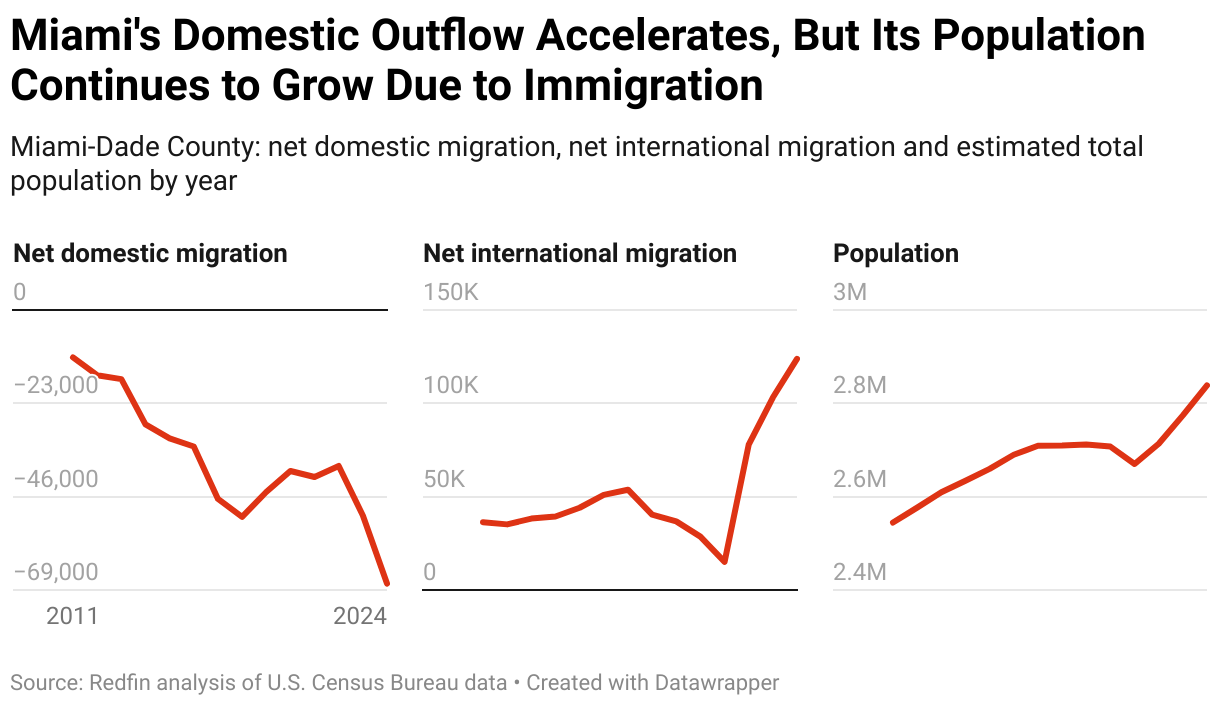
Many flood-prone areas saw their populations grow in 2024, but the Trump Administration’s crackdown on immigration could reverse that trend in 2025. Linares, the Miami agent, said he has seen a significant decrease in international business over the past eight months.
“Before I had homebuyers from Venezuela, Colombia, Brazil—any Spanish-speaking country you can think of,” he said. “They are non-existent in Miami now. We’re also seeing fewer people move in from Canada.”
Methodology
Climate risk data comes from First Street, which assigns six different climate-risk categories to properties across the U.S.—minimal, minor, moderate, major, severe and extreme. For this report, a “high-risk” home is one that falls into the major, severe or extreme category for a climate risk. We define a “high-risk” county as one that ranks in the top 10% when it comes to the share of homes facing high risk. That means a high-flood-risk county is one with 23.7%-99.1% of homes facing high risk. The remaining counties are referred to as low-risk counties. Climate-risk scores are based on a property’s current risk as well as how that risk is expected to grow over the next 30 years.
For every county identified, we calculated the net domestic migration for 2024 using the U.S. Census Bureau’s Vintage Population Estimates data. Net domestic migration is the difference between the number of people moving into an area and the number moving out.
The United States has 3,144 counties and statistically equivalent entities. Redfin included in this analysis 3,103—those for which there is both consistent migration data from the U.S. Census Bureau and flood-risk scores from First Street. The total net outflow among the 132 high-risk counties that saw outflows in 2024 was -184,249. The total net inflow among the remaining 178 high-risk counties was 155,222. The -29,027 national net outflow figure in section one of this report is the sum of -184,249 and 155,222.